




| Temperament |  |
Appearance | |
Size | |
Grooming |

The Samoyed is one of the most ancient breeds of dogs – having remained almost pure in its bloodlines. They travelled with the nomadic Samoyede people, in the Arctic Circle of east Siberia. The Samoyed was used to herd caribou and reindeer, as well as guarding against bears and wolves. When needed they could be used as sled and draught dogs or just to keep the families warm.
Samoyeds may be best known to the general public for their work as sled dogs in both Arctic and Antartic explorations. As the lead dog on Roald Amundsen’s expedition, a Samoyed was probably the first non-native creature to set foot (or paw) on the South Pole.
They are a true working dog; having served as a herder of reindeer, a sledge dog and as a household companion, watchdog and helper. All the major characteristics of today’s Samoyed – the erect ears, the smiling face, the buff to white coat and the the plumed tail – are natural and may be seen clearly in photographs of the breed from the early 1800’s.
The
Samoyed is a hardy breed with great strength and power. Its heavy,
weather-resistant coat helps it to withstand the freezing temperatures
of the arctic. Its independent temperament is a result of living
in a land of harsh conditions. Samoyeds are capable of fulfilling
most tasks asked of them and do so eagerly (but usually expect a reward).
INDEX
With a friendly and eager disposition the Samoyed makes a loyal family companion who enjoys playing with children. They are good guard dogs (but could expect you to actually bite the burglar), they are friendly and affectionate and good natured. They do better when included in the family (pack, from their viewpoint) than when left to themselves. They actually do not seem to realise that they are dogs!
They can be intelligent and obedient, although somewhat independent. They have unusual intelligence with almost uncanny human understanding, but can be very stubborn and they get bored easily. When it comes to obedience training Samoyeds are a challenge – they believe in enjoying their work and will work ‘with’ you but not ‘for’ you, so you may have to change your training methods.
Warning:
Samoyeds, if given an inch will take a mile. They can be TOO intelligent,
TOO independent and TOO manipulative for a soft-hearted person. They
will walk all over you but will allow you to live in their home, instead
of them in yours.
INDEX
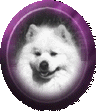
The noble charcteristics of the Samoyed are evident in the puppies – known as “Little White Teddy Bears”. They are a picture of beauty with the long fluffy coat and happy face. The Samoyed is said to have ‘the spirit of Christmas’ in its face all year long.
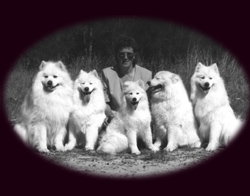
Adults give the appearance of great strength and stamina whilst also appearing graceful. A medium-sized dog, the Samoyed has a double coat of long white, cream or biscuit hair. The bushy tail is carried curled over the back. The almond shaped eyes are dark and lively and the mouth turns upwards to give a constantly smiling expression.
A
Samoyed ‘look’ is distinctive – with the smiling white face, the dark eyes
with dark eyerims and the dark lips curling up towards the corners to give
the truly Samoyed look of pure mischief. One of the few changes to
the breed appears to be the selecting for black noses in preference to
the ‘snow nose’ (pink/reddish markings on a black nose). However,
this can come and go with the weather so most breeders do not worry about
it.
INDEX
These heights are as applicable for Australia. The breed requirements vary from country to country.
Adults
should be: Dogs 51 – 56 cm (20 – 22 inches)
Bitches 46 – 51 cm (18 – 20 inches)
Weight should be in proportion to height – dogs would ideally be under 34 kg (75 lb) and bitches 20.5 – 25 kg (45 – 55 lb).
For
comparison purposes this means that Samoyeds should be the smallest of
the arctic breeds – Alaskan Malamute, Siberian Husky, Samoyed. They
should be 5 cm (2 inches) smaller that Collie Roughs, or approximately
the same height as Border Collies. Samoyeds should be a medium
sized breed.
INDEX
Samoyeds are a double coated breed and usually ‘drop’ coat twice a year. The remainder of the time general care in the average home entails regular brushing/combing. This can be on a daily basis or at weekly intervals – depending on the amount of grooming intended each time. Whilst dropping coat Samoyeds need to be combed out well, in order to avoid skin problems as well as to save your home from looking like a snow storm has hit. They do not need to be bathed too often as this can result in loss of coat and condition – once a year can be plenty.
Samoyeds are a very clean dog and do not have a natural ‘doggy’ odour – they tend to clean themselves much like a cat. Most dirt and stains tend to disappear within a day or two, sometimes with the aid of a little powder, but this is not always necessary.
NEVER clip a Samoyed for the summer. The double coat acts as insulation for heat just as much as for the cold.
If
alone they can require a lot of exercise - both on and off the leash.
If there are more than one they tend to exercise each other to a considerable
degree.
INDEX